Wednesday, 21 December 2022

New publication on climate and sex-ratio!

Santidrián Tomillo, P. 2022 When population-advantageous primary sex ratios are female-biased: changing concepts to facilitate climate change management in sea turtles. Climatic Change 175, 15, doi: https://doi.org/10.1007/s10584-022-03470-4

Abstract: Sea turtles have temperature-dependent sex determination. Because females are produced at high temperatures, increasing global temperature may lead to population feminization. Primary sex ratios (PSR) of sea turtle hatchlings are naturally female-biased, but this translates into a more balanced operational sex ratio because male turtles reproduce more often than females. As a consequence, a balanced PSR and the temperature that produces it (pivotal temperature) are of limited use to guide climate mitigation management because an equal PSR may be demographically suboptimal. 

Photo from wikipedia.org

Here, I define population-advantageous primary sex ratios (PA-PSR) as the PSR that will tend to be in equilibrium in a population and that will result in balanced operational sex ratios; I then estimate PA-PSR for different reproductive frequencies (years elapsed between reproductive seasons) of adult female and male turtles. I also define population equilibrium temperature (PET) as the temperature that would result in the equilibrium PSR of hatchlings (i.e., PA-PSR). These concepts may help assess the influence of rising temperatures on populations, as they can better indicate if PSRs depart from those at equilibrium. I compared PA-PSR and beach PSR for two populations of sea turtles for which male and female remigration intervals were known and found that a mild or no feminization over the PA-PSR may be occurring. Because PSR varies inter-annually, and hatchlings coming from beaches of different thermal conditions could recruit to the same population, it is critical to estimate beach PSR at the right temporal and spatial scales. Climate mitigation strategies based on these concepts could provide better management guidance for conservation practitioners. Similar approaches could be considered for other female-biased species with temperature-dependent sex determination.

Monday, 12 December 2022

New Publication on Lizard lifspan!

Rotger, A., Tenan, S., Igual, J.-M, Bonner, S. and Tavecchia, G., 2022. Life span, growth, senescence and island syndrome: Accounting for imperfect detection and continuous growth Journal or Animal Ecology,https://doi.org/10.1111/1365-2656.13842

Abstract:

  1. Small vertebrates on islands are expected to attain a larger body size, and a greater survival than their mainland counterparts. Comparative studies have questioned whether lizards exhibit this set of adaptations, referred to as the ‘island syndrome’.
  2. We collected data on 730 individuals the endemic Lilford's lizard Podarcis lilfordi throughout a 10-year period on a small island of the Balearic archipelago (Spain). We coupled a growth function with a capture–mark–recapture model to simultaneously estimate size- and sex-dependent growth rate and survival. To put our results into a wider context, we conducted a systematic review of growth, life span and age at maturity in different Podarcis species comparing insular and mainland populations.

  3. We found a low average growth coefficient (0.56 and 0.41 year−1 for males and females to reach an asymptotic size of 72.3 and 65.6 mm respectively), a high annual survival probability of 0.81 and 0.79 in males and females, and a large variability between individuals in growth parameters.
  4. Survival probability decreased with body size in both sexes, indicating a senescence pattern typical of long-lived species or in populations with a low extrinsic mortality. Assuming a constant survival after sexual maturity, at about 2 years old, the average life span was 6.18 years in males and 8.99 in females. The oldest animal was a male last captured at an estimated age of ≥13 years and still alive at the end of the study.
  5. Our results agree with the predictions of the ‘island syndrome’ for survival, life span and growth parameters. A comparative analysis of these values across 29 populations of 16 different species of Podarcis indicated that insular lizards grow slower and live longer than their mainland counterparts. However, our data differed from other island populations of the same species, suggesting that island-specific characteristics play an additional role to isolation.
  6. Within this study we developed an analytical approach to study the body size-dependent survival of small reptiles. We discuss its applicability to contrast hypotheses on senescence in different sexes of this species, and provide the code used to integrate the growth and capture–mark–recapture models.

Thursday, 1 December 2022

GEDAi at the Spanish Ornithological Congress 9-13/11/2022 !

This fall the GEDAi joined the 25th Spanish Ornithological Congress.

A. Sanz-Aguilar was on the scientific committee. A. Santangeli and S. Bolumar made a poster presentation of their work and projects.

Monday, 28 November 2022

New Publication on early-life conditions !

Payo-Payo, A. Sanz-Aguuilar, A. and Oro, D. 2022. Long-lasting effects of harsh early-life conditions on adult survival of a long-lived vertebrate. Oikos e09371, https://doi.org/10.1111/oik.09371

Summary: Early life conditions, especially in long-lived organisms, can have both immediate and long-lasting effects in vital traits generating demographic structure across cohorts. Multiple non-exclusive hypotheses have been proposed to explore this question. For instance, the silver spoon, the viability selection or the predictive adaptive response hypothesis, predict that long lasting effects resulting from harsh early conditions could be negative, positive or vary with current environmental conditions, respectively. We use an 18-year capture–mark–recapture dataset on adult Audouin's gulls Ichthyaetus audouinii to test for these different hypotheses while accounting for age, breeding experience and large-scale dispersal. Audouin's gull cohorts experiencing harsh conditions during early life (i.e. nestling period and first winter) are known to experience lower first year survival. Here, we show that early life conditions also explained a large proportion (54%) of adult survival variation among cohorts. However, adulthood cohorts experiencing poor early life conditions had higher adult survival, in accordance with the viability selection hypothesis. Our results also show that apparent inexperienced breeders showed lower survival than experienced ones. Moreover, adult survival decreased with age. These results could suggest an increased cost of reproduction for deferred breeders, individual quality differences or survival senescence in this population. Overall, our study highlights the importance of early development, age and breeding experience as potential factors generating heterogeneity of survival between cohorts. Understanding the mechanisms driving responses to early life conditions at different life stages is fundamental to understanding the long-term dynamics of wild populations.

Friday, 25 November 2022

CMR Workshop ended!

The 2022 Workshop on capture-mark-recapture and- recovery data applied to conservation of animal populations ended today! It has been an interesting and stimulating workshop. This year we had datasets on vultures, trouts, dolphins, sharks, gulls ... We always learn new systems, new challenges, new studies and more important new persons. 

Thanks to all for coming!


Monday, 21 November 2022

"La Caixa" Foundation Fellowships. Apply and join the GEDA!

Incoming call for  INPhINIT Doctoral Fellowship ("LA CAIXA" Foundation) !! 
 
Are you interested in obtaining a Ph.D. on seabirds ecology ? The La Caixa Foundation grants 65 fellowships for talented early-stage researchers of any nationality to pursue their PhD studies in Spain or Portugal.  Apply at   https://fundacionlacaixa.org/en/inphinit-doctoral-fellowships-call and select our project. Find our project on seabirds (here) and join the GEDAi

Research Project / Research Group Description

Seabirds are in rapid decline worldwide, but the relative importance of the multiple threats to their populations is not always clear, nor the birds’ response to current global changes.  As top-predators their behavior, dynamics and life-history strategy reflect ocean state and condition and their decline is showing that the marine ecosystems is changing. 

Photo: Victor Paris
The research project aims to investigate the life-history strategy of seabirds under the current chemo-physical changes of the ocean. The project will take advantage of the long term monitoring databases collected by the team and the data collected by GPS and GLS devices to follow birds during their foraging movements and migratory routes. It will focus on two species of conservation interest, belonging to the order of Procellariformes, the European storm petrel Hydrobates pelagicus and the Scopoli’s shearwater Calonectris diomedea. Birds will be studied in the Balearic archipelago and Alicante region (Eastern Spain). The deployment of tracking devices will allow to investigate the individual and the species-specific movements in order to detect the important foraging and overwinter areas to help policy makers to reduce the threats to their populations.

 If you need more information on the project: g.tavecchia-at-uib.es

Apply here!!

Wednesday, 9 November 2022

New Publication on Sea Turtles range expansion!

Santidrián Tomillo, P., Tomás, J., Marcos, A., Panagopoulou,A. and Tavecchia,G. 2022 Enviornmental changes in the Mediterranean Sea could facilitate the western expansion of loggerhead turtles. MEPS DOI: https://doi.org/10.3354/meps14149

ABSTRACT: Climate change may affect life on Earth in multiple ways. Whereas some populations may encounter detrimental conditions that cause extirpations, those occupying cooler thermal limits of a range may benefit by expanding. For sea turtles, egg maturation in the female oviduct and nest incubation are temperature-dependent and vulnerable to climate change. 

Mediterranean loggerhead turtles Caretta caretta nest in the eastern basin although sporadic nesting occurs on the western side. To assess the likelihood of a climate-related expansion, we compared historical air and sea surface (SST) temperatures between locations near established eastern nesting areas and western areas where sporadic nesting is increasing (Palinuro, Italy) or just started (Balearic Islands, Spain). Our results suggest that summer air and water temperatures in western sites were suitable for nesting over the last 40-50 yr, at least in July-August, having (1) SSTs above suboptimal threshold temperature (22°C) and (2) similar air temperatures to those of Greece, but among the lowest in the Mediterranean. There was a decreasing east-to-west gradient in SST. However, SSTs were similar around beaches of Zakynthos (Greece), Palinuro and Ibiza (Balearic Islands), where SST was above 22°C for at least 60 d, potentially allowing turtles to lay multiple clutches. A warming trend was detected in air temperature and SST since the 1970s-1980s. Although conditions in the western Mediterranean currently seem suitable for nesting, lower air temperatures in May-June and higher precipitation in September could shrink the nesting window. If warming continues, conditions in the western basin could progressively become more favorable for nesting. 

Friday, 4 November 2022

New Publication on Synchrony !

Payo-Payo, A., Igual,J.-M., Sanz-Aguilar, A., Real, E., Genovart, M., Oro, D., Tavecchia, G., 2022 Interspecific synchrony on breeding performance and the role of anthropogenic food subsidies. PLoS One, https://doi.org/10.1371/journal.pone.0275569 

Abstract. Synchrony can have important consequences for long-term metapopulations persistence, community dynamics and ecosystems functioning. While the causes and consequences of intra-specific synchrony on population size and demographic rates have received considerable attention only a few factors that may affect inter-specific synchrony have been described. We formulate the hypothesis that food subsidies can buffer the influence of environmental stochasticity on community dynamics, disrupting and masking originally synchronized systems.

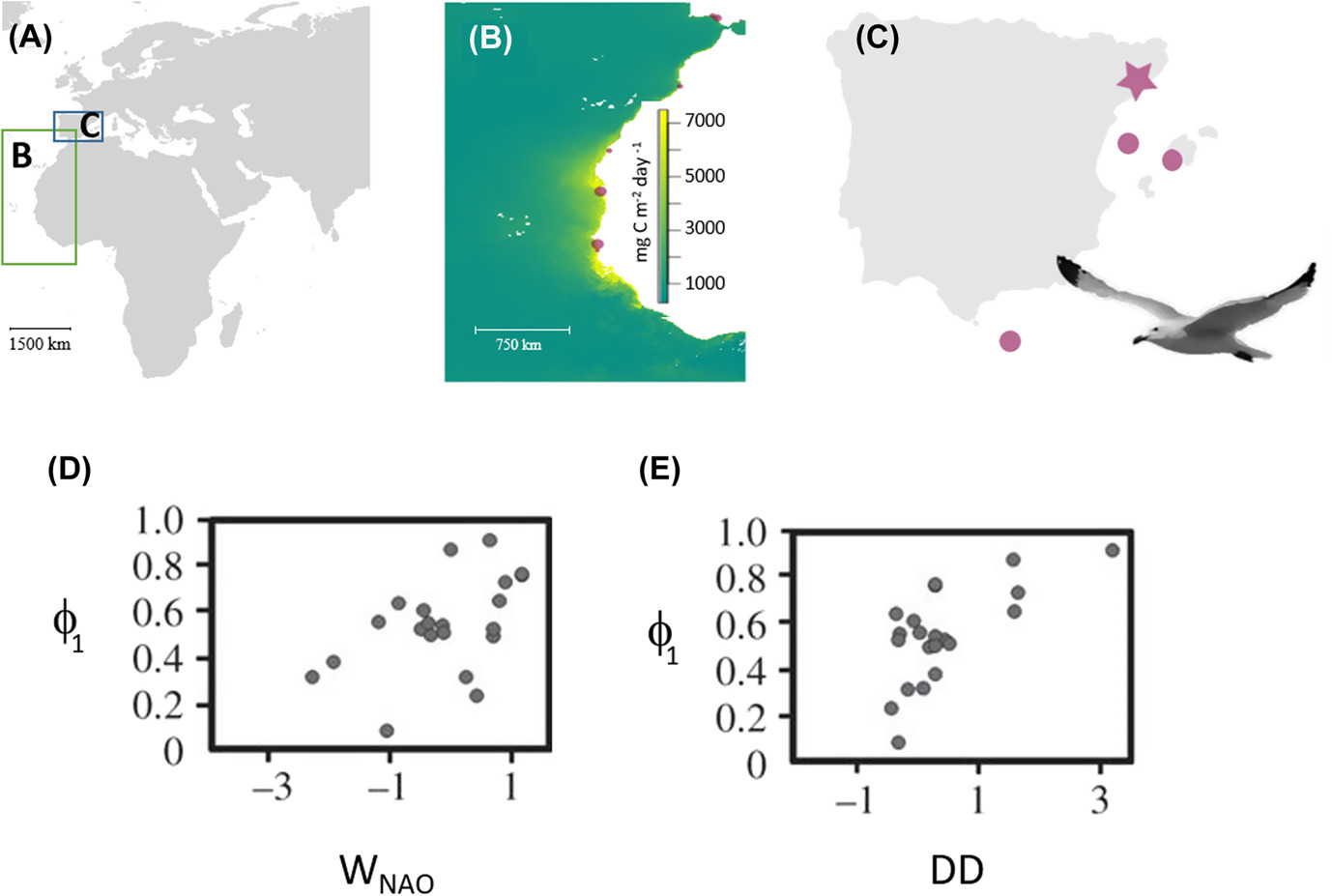
 To illustrate this hypothesis, we assessed the consequences of European policies implementation affecting subsidy availability on the temporal synchrony of egg volume as a proxy of breeding investment in two sympatric marine top predators with differential subsidy use. We show how 7-year synchrony appears on egg volume fluctuations after subsidy cessation suggesting that food subsidies could disrupt interspecific synchrony. Moreover, cross correlation increased after subsidy cessation and environmental buffering seems to act during synchronization period. We emphasize that subsidies dynamics and waste management provide novel insights on the emergence of synchrony in natural populations.

Subscriptions to CMRR 2026 workshop open!

Subscription to the upcoming workshop on CMRR analysis, now open.  INTRODUCTORY COURSE : 23 - 27 Nov. 2026, Mallorca, Spain     (places: 20,...