Showing posts with label tracking. Show all posts

Wednesday, 11 September 2024

Award for the best talk on seabird tracking!

Sofia Bolumar Roda has been awarded with a price for the best talk on seabird tracking at the "Seabird Group Conference" held in Coimbra, Portugal. Sofia's research coupled oceanic variables with the foraging movements of the European Storm Petrel. 
 
Well done, Sofia!  Congratulations!


Friday, 18 March 2022

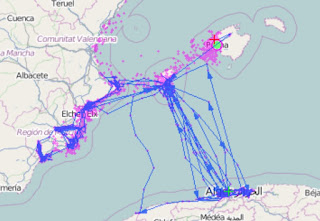
First time in Africa!


For the first time since 2016, one Yellow legged gull marked with GSM/GPS has visited Africa. It might be a consequence of the transformation of the open-air landfill occurred last year. These animals do not stop to surprise us!


Thursday, 4 March 2021

New publication on albatross and large petrels!

Beal, M, Dias, M.P,...[Igual, J.-M.]...,Catry, P., 2021.Global political responsibility for the conservation of albatrosses and large petrels. Science Advances doi: 10.1126/sciadv.abd7225

Abstract: Migratory marine species cross political borders and enter the high seas, where the lack of an effective global management framework for biodiversity leaves them vulnerable to threats. Here, we combine 10,108 tracks from 5775 individual birds at 87 sites with data on breeding population sizes to estimate the relative year-round importance of national jurisdictions and high seas areas for 39 species of albatrosses and large petrels. Populations from every country made extensive use of the high seas, indicating the stake each country has in the management of biodiversity in international waters. We quantified the links among national populations of these threatened seabirds and the regional fisheries management organizations (RFMOs) which regulate fishing in the high seas. This work makes explicit the relative responsibilities that each country and RFMO has for the management of shared biodiversity, providing invaluable information for the conservation and management of migratory species in the marine realm

.

Thursday, 3 September 2020

Cover!

A picture by Victor Paris was selected for the Cover of the 68th volume of the journal ARDEOLA to illustrate Rotger, A. et al. publication Foraging far from home: GPS-tracking of Mediterranean Storm Petrel reveals long.distance foraging movements. Congrats Victor, amazing picture!


Friday, 26 June 2020

Storm Petrels on the news !

The work by A Sanz-Aguilar and A. Rotger on the first tracks of Storm Petrels breeding in the Balearic Archipelago hit the news! here


Monday, 3 February 2020

New Publication on vultures and human activities!

Arrondo, E, Sanz-Aguilar, A., Pérez-Garcia, J., Cortés-Avizanda, A., Sánchez-Zapata, J.A., Donazár, J.A. 2020 Landscape anthropization shapes the survival of a top avian scavenger Biodiversity and Conservation.pp 1–15  https://doi.org/10.1007/s10531-020-01942-6)
Photo: M. Gomila
Abstract. Events of non-natural mortality in human-dominated landscapes are especially challenging for populations of large vertebrates with K strategies. Among birds, vultures are one of the most threatened groups experiencing sharp population declines due to non-natural mortality. Factors causing non-natural mortality are usually studied separately. However, the potential use of an integrated index able to predict large-scale mortality risks of avian scavengers could be especially useful for planning conservation strategies.
Here, we used the Human Footprint index to examine the impact of landscape anthropization on the survival rates of 66 GPS-tagged adult Eurasian griffon vultures (Gyps fulvus) in two Spanish regions. Foraging in more anthropized areas resulted in a significantly higher individual mortality risk mainly due to collisions with vehicles, poisonings, electrocutions and fatalities with wind turbines. Mean yearly survival rates were estimated at 0.817 ± 0.043 SE and 0.968 ± 0.018 SE for individuals from the more and less anthropized regions, respectively. Additional research should investigate whether some vulture populations could be acting as sinks unnoticed due to metapopulation dynamics. From a broader point of view, our study shows that a straightforward Human Footprint was a useful index to predict the survival of top scavengers and can be highly applicable to planning large-scale conservation measures.
A recent press release (in Spanish) here

Thursday, 30 January 2020

GEDA at AESA

Ainara Cortés-Avizanda presented her project on the space use of vultures in Mallorca at the "Agencia Estatal de Seguridad Aerea" (AESA).

Friday, 22 November 2019

New publicatoion: when and where Black Kites die !

Sergio, F., Tavecchia, G., Tanferna, A., Blas, J., Blanco, G., and Hiraldo, F. 2019: When and where mortality occurs throughout the annual cycle changes with age in a migratory birds: indiviudal vs population implications. Scientific Reports, 9, 17352.

Photo: F. Sergio
Abstract: The annual cycle of most animals is structured into discrete stages, such as breeding, migration and dispersal. While there is growing appreciation of the importance of different stages of an organism’s annual cycle for its fitness and population dynamics, almost nothing is known about if and how such seasonal effects can change through a species lifespan. Here, we take advantage of the opportunity offered by a long-term satellite/GPS-tracking study and a reliable method of remote death-detection to show that certain stages of both the annual and life cycle of a migratory long-lived raptor, the Black kite Milvus migrans, may represent sensitive bottlenecks for survival. In particular, migratory journeys caused bursts of concentrated-mortality throughout life, but the relative importance of stage-specific survival changed with age. On the other hand, the balance between short-stages of high mortality and long-stages of low mortality made population-growth similarly dependent on all portions of the annual cycle. Our results illustrate how the population dynamics of migratory organisms can be inextricably linked to ecological pressures balanced over multiple stages of the annual cycle and thus multiple areas of the globe, suggesting the frequent need for challenging conservation strategies targeting all portions of a species year-round range.

New publication on red-necked nightjars!

Hidalgo-Rodríguez, P, Sanz-Aguilar, A., Edelaar P., [...],  Camacho, C. 2026 Temperature extremes across breeding and nonbreeding regions sh...