
Showing posts with label Cory's Shearwater. Show all posts
Showing posts with label Cory's Shearwater. Show all posts
Friday, 13 October 2023
Shearwaters on the news!

Friday, 4 November 2022
New Publication on Synchrony !
Payo-Payo, A., Igual,J.-M., Sanz-Aguilar, A., Real, E., Genovart, M., Oro, D., Tavecchia, G., 2022 Interspecific synchrony on breeding performance and the role of anthropogenic food subsidies. PLoS One, https://doi.org/10.1371/journal.pone.0275569
Abstract. Synchrony can have important consequences for long-term metapopulations persistence, community dynamics and ecosystems functioning. While the causes and consequences of intra-specific synchrony on population size and demographic rates have received considerable attention only a few factors that may affect inter-specific synchrony have been described. We formulate the hypothesis that food subsidies can buffer the influence of environmental stochasticity on community dynamics, disrupting and masking originally synchronized systems.

Friday, 19 March 2021
New publication on seabirds and stable isotopes !
Ramírez F, Vicente-Sastre D, Afán I, Igual JM, Oro D, Forero MG (2021) Stable isotopes in seabirds reflect changes in marine productivity patterns. Mar Ecol Prog Ser 662:169-180. https://doi.org/10.3354/meps13615
ABSTRACT: Seabirds have been proposed as suitable candidates for tracking and monitoring changes in marine systems (bioindicators). However, their suitability depends on our ability to link the large degree of environmental variability inherent to marine systems with a few, relevant, and accessible signals (biomarkers) informing on changes in their feeding behavior or reproductive performance. We combined satellite remote-sensing records with stable isotope data (δ15N and δ13C) and breeding parameters (fledging success) spanning several years (2001-2014) to investigate the ecological responses to environmental variability by 2 sympatric seabirds inhabiting the western Mediterranean: Scopoli’s shearwater Calonectris diomedea and Cory’s shearwater C. borealis.

Both species showed similar annual variations in their stable isotopic
composition, likely as a response to the trophic consequences of changes
in the magnitude and timing of the annual peak in marine productivity
(as proxied by satellite imagery of chlorophyll a
concentrations). In contrast, no relevant responses were observed in
their breeding performance, suggesting that their life-history strategy
has evolved to constancy in breeding success, which diminishes its value
as a biomarker of changes in marine productivity patterns. Despite this
limitation, combining remote sensing and stable isotopes in seabirds is
a reliable and powerful tool for the early detection of fine-scale,
climate-driven changes in marine productivity patterns and its cascading
effects across communities and trophic levels, especially under the
current scenario of ocean warming.
Friday, 5 June 2020
The Shearwater campaign 2020 on the starting blocks

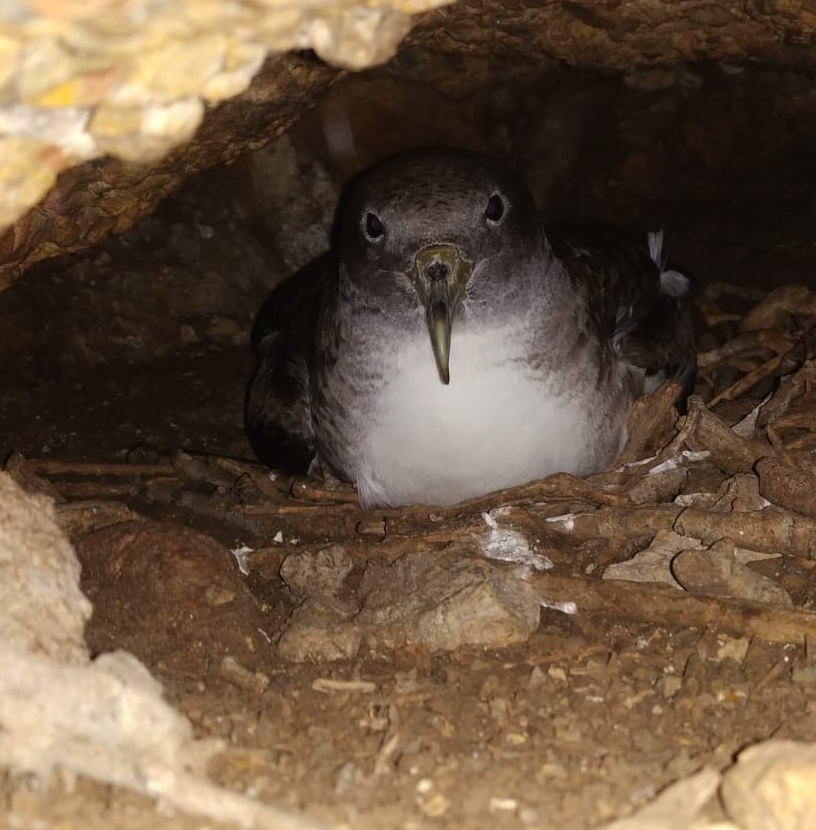
Saturday, 19 October 2019
Stranded !
Cory's shearwater fledglings are leaving the nest. Some of them get attracted by the light of the cities along the shore and cannot find the way back to the sea.

Please call 112 if you find one.

Tuesday, 30 July 2019
Shearwater campaign (part I) ended!
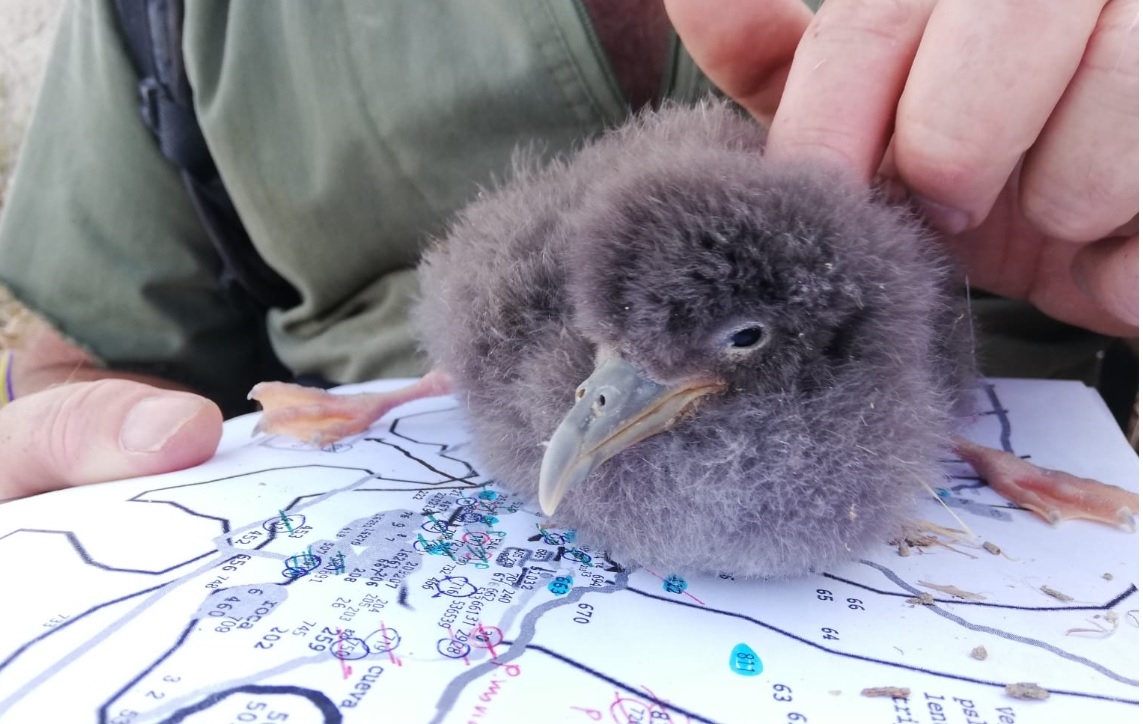 Today was the last visit to the Shearwater colony to measure hatching success.
Friday, 29 March 2019
Master on Marine Ecology with the GEDA
 |
| M. Martin Perez |
 |
| A. Sola |
 |
| M. Castell |
Their respective fieldwork campaigns are on the starting blocks !
Tuesday, 22 May 2018
The Cory's Shearwaters began to breed !
 |
| Photo: A. Sanz-Aguilar |
Subscribe to:
Posts (Atom)
New publication on red-necked nightjars!
Hidalgo-Rodríguez, P, Sanz-Aguilar, A., Edelaar P., [...], Camacho, C. 2026 Temperature extremes across breeding and nonbreeding regions sh...

-
 Mingozzi, T., Storino, P., Venuto, G., Massolo, A., Tavecchia, G., 2021. Climate warming induced a streth of the breeding season and an incr...
 -
 S Bolumar and A Santangeli are participating to the XXII Italian Ornithology Conference in Lecce
