Thursday, 30 May 2019

New Publication on invasive species and social perception!

Luna,A., Edelaar, P., Shwartz, A. 2019. Assesment of social perception of an invasive parakeet using a novel visual survey method. NeoBiota, 46:71-89. https://doi.org/10.3897/neobiota.42.31017

Photo: R. Kasambe, source: Wikipedia

Abstract:The perceptions of the general public regarding invasive alien species (IAS) are important in the prevention of future invasions and the success of management programmes. Here we use a novel visual method to investigate the perception of a charismatic IAS, the rose-ringed parakeet, across different stakeholders in Seville, Spain. Respondents were asked to select images of 10 bird species they would like to have present in their surroundings, out of 20 available images, including the parakeet and three other non-natives. This makes the survey easy, fast to take and attractive to potential participants, while prior and potentially biasing information of survey goals is minimised. Although more than 95% of the respondents recognised the parakeet, at least up to family level, only 34.8% selected it. Selection rates were even lower for three other IAS and even more so when the status of non-native species was indicated next to the images, suggesting that a social norm against IAS may be established. To validate our novel visual approach, we also assessed perception via a traditional questionnaire and the results of the two survey methods coincided. Finally parakeet selection differed importantly amongst pre-defined sectors of the public and people who had prior experience with the parakeet selected it less frequently (e.g. farmers, park managers). These results highlight the importance of studying different stakeholders to get the full picture when considering IAS management programmes. Our new visual survey method can thus serve as an excellent and user-friendly tool to study people’s perceptions regarding charismatic IAS and facilitate well-informed and sensible decision-making.

Monday, 27 May 2019

New Publication on scavangers in the Anthropocene!

Sebastián-González, E., [...], Cortés-Avizanda, A., [...] 2019. Scavenging in the Anthropocene: human impact drives vertebrate scavenger species richness at a global scale. Global Change Biology https://doi.org/10.1111/gcb.14708

Photo: Chris Johns, Nat. Geogr. Education
Abstract: Understanding the distribution of biodiversity across the Earth is one of the most challenging questions in biology. Much research has been directed at explaining the species latitudinal pattern showing that communities are richer in tropical areas; however, despite decades of research, a general consensus has not yet emerged. In addition, global biodiversity patterns are being rapidly altered by human activities. 
Here, we aim to describe large‐scale patterns of species richness and diversity in terrestrial vertebrate scavenger (carrion‐consuming) assemblages, which provide key ecosystem functions and services. We used a worldwide dataset comprising 43 sites, where vertebrate scavenger assemblages were identified using 2,485 carcasses monitored between 1991‐2018. First, we evaluated how scavenger richness (number of species) and diversity (Shannon diversity index) varied among seasons (cold vs. warm, wet vs. dry). Then, we studied the potential effects of human impact and a set of macroecological variables related to climatic conditions on the scavenger assemblages. Vertebrate scavenger richness ranged from species‐poor assemblages to species‐rich (4 ‐ 30 species). Both scavenger richness and diversity also showed some seasonal variation. However, in general, climatic variables did not drive latitudinal patterns, as scavenger richness and diversity were not affected by temperature or rainfall. Rainfall seasonality slightly increased the number of species in the community, but its effect was weak. Instead, the human impact index included in our study was the main predictor of scavenger richness. Scavenger assemblages in highly human‐impacted areas sustained the smallest number of scavenger species, suggesting human activity may be over‐riding other macroecological processes in shaping scavenger communities. Our results highlight the effect of human impact at a global scale. As species‐rich assemblages tend to be more functional, we warn about possible reductions in ecosystem functions and the services provided by scavengers in human‐dominated landscapes in the Anthropocene.

Tuesday, 14 May 2019

Wind Power and Biodiversity

A. Sanz-Aguilar has collaborated on the video "Wind Power and Biodiversity" (in Spanish) where vultures are sentinels of Wind Power mortality.


Friday, 10 May 2019

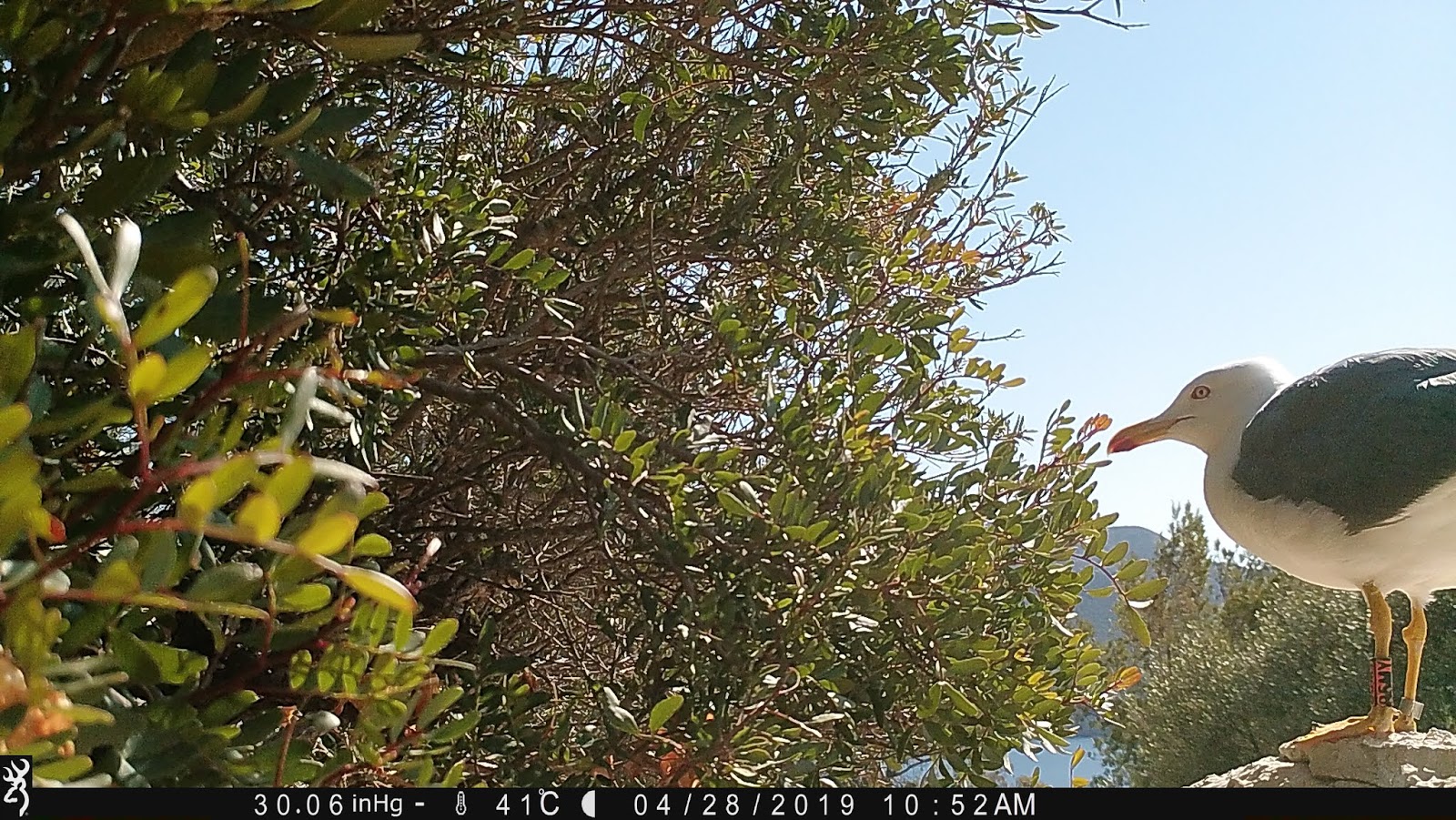
Caught on camera !

This year we planned camera-trapping (left) and photos by trigger-happy photographs (below) to increase recapture rate. 
Both methods resulted in additional readings to those made by telescope alone. After these encouraging results we will be probably using these techniques regularly. A special thanks to Miguel, Javi y Paco for the nice images.


Thursday, 2 May 2019

Press release !

The last work published by members of the GEDA received media attention:

REWILDING (here)
RED KITE IN SOUTHERN SPAIN (here)

Sunday, 28 April 2019

New Publication on rewilding !

Perino, A., Pereira, H.M., [..], Cortés-Avizanda,A.,[...] and Wheeler, H.C., 2019. Rewilding complex ecosystems. Science 364, DOI: 10.1126/science.aav5570 

Abstract: The practice of rewilding has been both promoted and criticized in recent years. Benefits include flexibility to react to environmental change and the promotion of opportunities for society to reconnect with nature. Criticisms include the lack of a clear conceptualization of rewilding, insufficient knowledge about possible outcomes, and the perception that rewilding excludes people from landscapes. Here, we present a framework for rewilding that addresses these concerns. We suggest that rewilding efforts should target trophic complexity, natural disturbances, and dispersal as interacting processes that can improve ecosystem resilience and maintain biodiversity. We propose a structured approach to rewilding projects that includes assessment of the contributions of nature to people and the social-ecological constraints on restoration. 


Thursday, 25 April 2019

New publication on Red Kite in Doñana National Park !

Sergio F, Tanferna A, Chicano J, Blas J, Tavecchia G, Hiraldo F. 2019 Protected areas under pressure: decline, redistribution, local eradication and projected extinction of a threatened predator, the red kite, in Doñana National Park, Spain Endangered Species Research. 38: 189-204

Photo: S. Sergio
Abstract: After a period of overfocus on reserve establishment, growing attention is being devoted to the capability of protected areas to maintain viable populations of endangered species. Here, we examined the trends and reproduction of the red kite Milvus milvus, a highly endangered raptor near-endemic to Europe, to illustrate the dual benefits and challenges faced by a national park to protect this iconic species. Over the past 4 decades, the kite population of southern Spain has declined steeply and become progressively confined to Doñana National Park and its buffering Natural Park. Population deterioration was also evident within the protected area through (1) spikes of rapid eradication of whole sub-populations from buffer areas, likely propelled by illegal poisoning, and (2) more gradual but steady deterioration of numbers and reproduction, especially in peripheral-buffer areas, probably caused by the interplay of several shocks related to food availability, habitat degradation, competition, predation, and chemical contamination. The result was a 46–55% decline with progressive confinement to the core National Park and an alarming effective population size <10 pairs. Demographic modelling suggested low adult survival and predicted further declines, with possible extinction over the next 2 decades. We outline tentative goals for management, but these will need urgent information on ranging and mortality to provide more efficient targets. These results illustrate how establishment of a large park can prevent regional extinction, but not necessarily guarantee species-safety, leading to protracted forms of extinction debt. We suspect that similar dynamics will become more widespread as anthropogenic pressures increase around protected areas and their performance-monitoring becomes more prevalent.

Tuesday, 16 April 2019

Yellow-Legged Gull campaign 2019!

Yellow-legged gull campaign on the starting blocks! It will be our 13th year and looking forward to see how the gulls did this year.


Subscriptions to CMRR 2026 workshop open!

Subscription to the upcoming workshop on CMRR analysis, now open.  INTRODUCTORY COURSE : 23 - 27 Nov. 2026, Mallorca, Spain     (places: 20,...