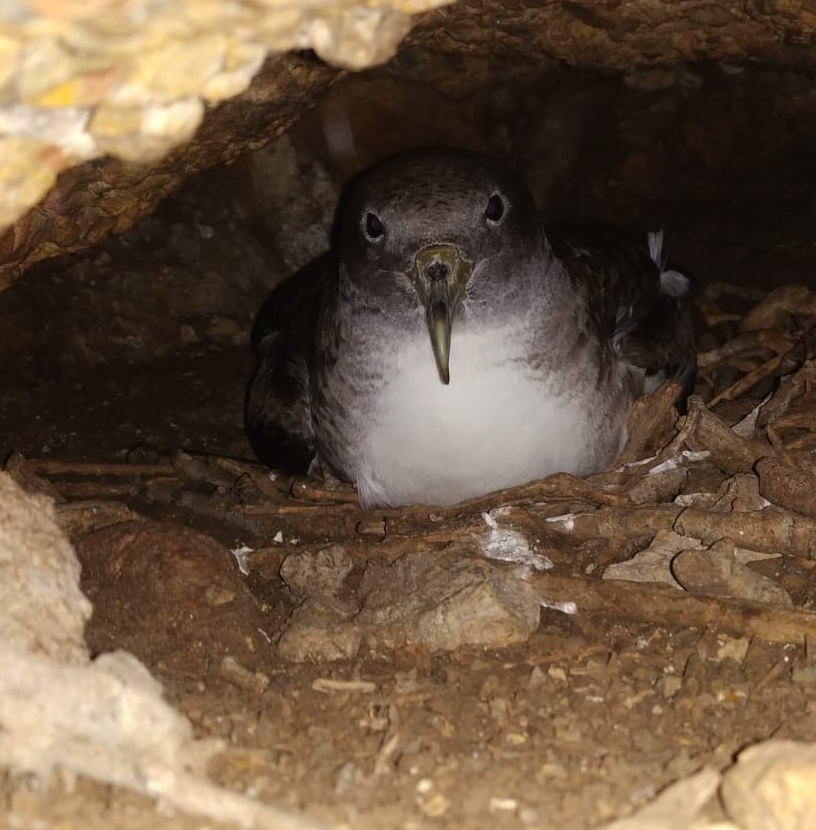
The work by A Sanz-Aguilar and A. Rotger on the first tracks of Storm Petrels breeding in the Balearic Archipelago hit the news! here


 in the Balearic archipelago has began. Birds are breeding late this year and expecially in this colony. Keep posted to know the foraging tracks!
 and other species has been classically addressed by means of
stable-isotope comparisons, but the extremely varied isotope signatures
found in ammunition hinders this identification when it overlaps with
topsoil signatures.
and other species has been classically addressed by means of
stable-isotope comparisons, but the extremely varied isotope signatures
found in ammunition hinders this identification when it overlaps with
topsoil signatures. 
 |
| Photo:wikipedia.org |
 We formulated a multievent capture-mark-recapture model to estimate survival while accounting for probabilities of resighting by citizens and/or camera traps, recovery of dead individuals, and loss of the wing tag. Survival was relatively high for juveniles (0.79), and increased with age to 0.95. Citizen observations of live and dead birds were low in number. However, when combined with camera trap resightings of live individuals, citizen observations increased the precision of survival estimates of birds older than one year compared to using data from either sources separately. Wing tag loss was high after 5–6 years of tag age. If neglected, tag loss can result in severe underestimation of survival of the older age classes. Overall, we show that filling ecological knowledge gaps is possible through the efficient use of data provided by different sources, and by applying state-of the art approaches that minimise potential biases, such as those due to tag loss.
 It was about eight years that the species did not breed in this islet.
  Unfortuntaley, there were some (illegal) visitors. Let 's hope nobody will disturb the new colony for three more weeks.
Subscription to the upcoming workshop on CMRR analysis, now open. INTRODUCTORY COURSE : 23 - 27 Nov. 2026, Mallorca, Spain (places: 20,...