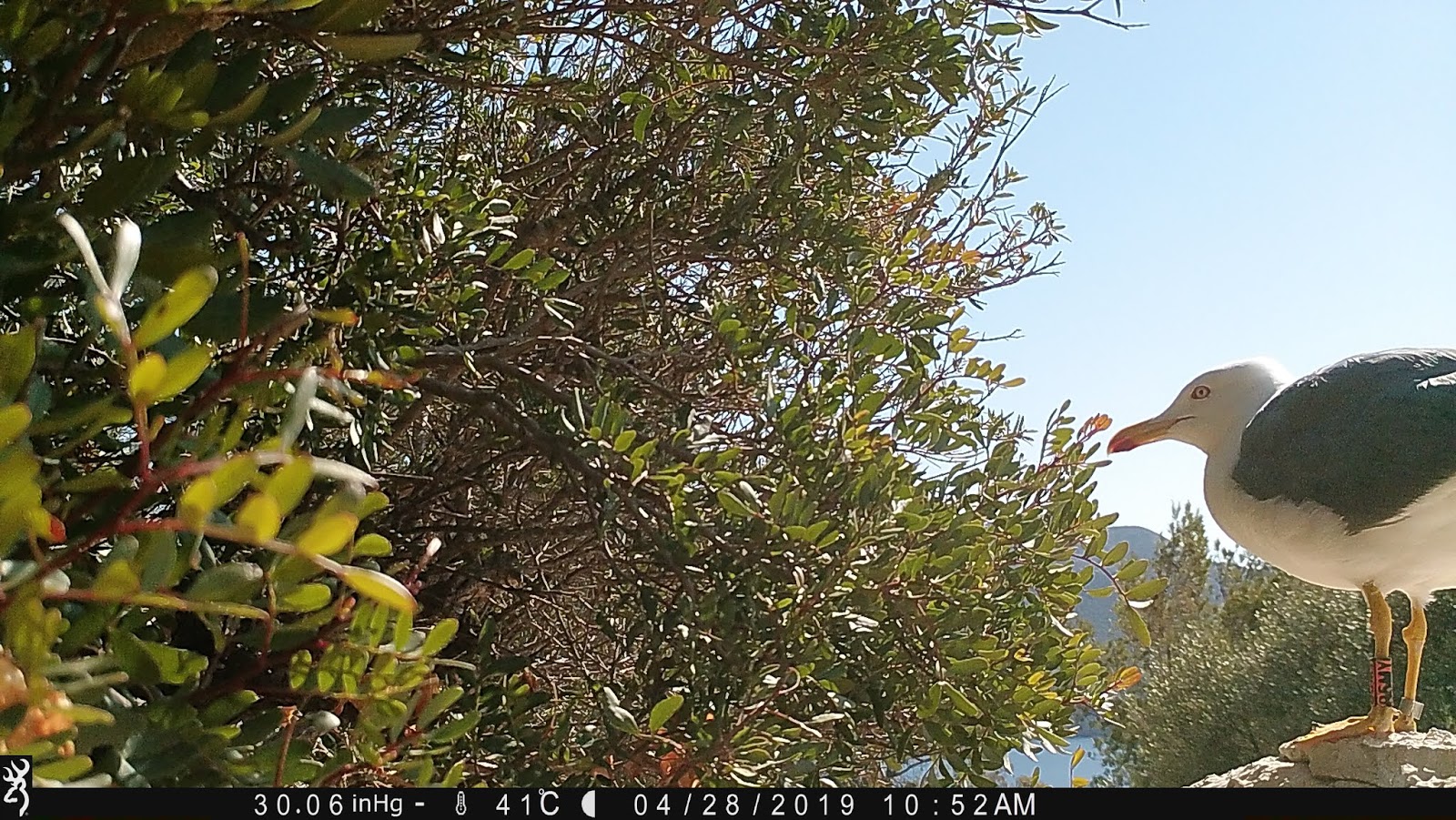
This year we planned camera-trapping (left) and photos by trigger-happy photographs (below) to increase recapture rate.
Both methods resulted in additional readings to those made by telescope alone. After these encouraging results we will be probably using these techniques regularly. A special thanks to Miguel, Javi y Paco for the nice images.
This blog tracks the scientific activity of the Animal Demography and Ecology Unit of the IMEDEA (CSIC-UIB). Contents on animal demography, capture-recapture, APHIS, upcoming workshop, publications
Friday, 10 May 2019
Thursday, 2 May 2019
Press release !
The last work published by members of the GEDA received media attention:
REWILDING (here)
REWILDING (here)
- IMEDEA press release
- CSiC Press note
- ‘Rewilding’ o cómo dejar que la naturaleza recupere su estado salvaje (La Vanguardia)
- ‘Rewilding’ o cómo dejar que la naturaleza recupere su estado salvaje (Sinc)
- El impacto del 94% de las especies exóticas marinas se desconoce (El País)
- Científicos piden revisar los proyectos de restauración de los ecosistemas (La Vanguardia)
- Lo mejor que podemos hacer con la España vacía no es repoblarla sino llenarla de bichos (El confidencial)
- 'Rewilding' o cómo dejar que la naturaleza recupere su estado salvaje (Público)
- Un grupo de investigadores propone una aproximación para ayudar a que los ecosistemas sean sostenibles (Dicyt)
- ‘Rewilding’ o cómo dejar que la naturaleza recupere su estado salvaje (El Boletin)
- Científicos piden revisar los proyectos de restauración de los ecosistemas (El Periódico)
- Investigadores proponen una aproximación para ayudar a que los ecosistemas sean sostenibles (PersonXXI)
- Investigadores ayudan a Ecosistemas Sostenibles (Revistanuve)
- Piden revisar la restauración de los ecosistemas (La Razón)
- Claves para crear ecosistemas realmente sostenibles (Elclickverde)
- IMEDEA press release
- CSIC Press Note
- Video Youtube en El Pais:https://youtu.be/yUNGQs7rsUE
- Reportaje EL PAIShttps://elpais.com/elpais/2019/04/24/ciencia/1556126835_752317.html
- Reportaje LAANGUARDIAhttps://www.lavanguardia.com/vida/20190425/461857772258/cientificos-advierten-de-la-extincion-del-milano-real-en-andalucia-en-20-anos.html
- Reportaje Natura Hoyhttp://www.naturahoy.com/naturaleza/el-milano-real-esta-al-borde-de-la-extincion-en-andalucia/
- Reportaje La Sexta https://www.lasexta.com/tecnologia-tecnoxplora/sinc/milano-real-borde-extincion-andalucia_201904255cc1aeb60cf2e2c19b6d356c.html
- Video en MSNhttps://www.msn.com/es-es/deportes/futbol/el-milano-real-est%C3%A1-al-borde-de-la-extinci%C3%B3n-en-el-sur-de-espa%C3%B1a/vi-BBWhxbr
- Reportaje Europa Presshttps://www.europapress.es/andalucia/noticia-milano-real-puede-desaparecer-andalucia-dentro-20-anos-si-no-toman-medidas-estudio-csic-20190425142843.html
- Reportaje The World News https://theworldnews.net/es-news/el-milano-real-esta-al-borde-de-la-extincion-en-el-sur-de-espana
Sunday, 28 April 2019
New Publication on rewilding !
Perino, A., Pereira, H.M., [..], Cortés-Avizanda,A.,[...] and Wheeler, H.C., 2019. Rewilding complex ecosystems. Science 364, DOI: 10.1126/science.aav5570
Abstract: The practice of rewilding has been both promoted and criticized in
recent years. Benefits include flexibility to react to environmental
change and the promotion of opportunities for society to reconnect with
nature. Criticisms include the lack of a clear conceptualization of
rewilding, insufficient knowledge about possible outcomes, and the
perception that rewilding excludes people from landscapes. Here, we
present a framework for rewilding that addresses these concerns. We
suggest that rewilding efforts should target trophic complexity, natural
disturbances, and dispersal as interacting processes that can improve
ecosystem resilience and maintain biodiversity. We propose a structured
approach to rewilding projects that includes assessment of the
contributions of nature to people and the social-ecological constraints
on restoration.
Abstract: The practice of rewilding has been both promoted and criticized in
recent years. Benefits include flexibility to react to environmental
change and the promotion of opportunities for society to reconnect with
nature. Criticisms include the lack of a clear conceptualization of
rewilding, insufficient knowledge about possible outcomes, and the
perception that rewilding excludes people from landscapes. Here, we
present a framework for rewilding that addresses these concerns. We
suggest that rewilding efforts should target trophic complexity, natural
disturbances, and dispersal as interacting processes that can improve
ecosystem resilience and maintain biodiversity. We propose a structured
approach to rewilding projects that includes assessment of the
contributions of nature to people and the social-ecological constraints
on restoration. Thursday, 25 April 2019
New publication on Red Kite in Doñana National Park !
Sergio F, Tanferna A, Chicano J, Blas J, Tavecchia G, Hiraldo F. 2019 Protected areas under pressure: decline, redistribution, local eradication and projected extinction of a threatened predator, the red kite, in Doñana National Park, Spain Endangered Species Research. 38: 189-204
Abstract: After a period of overfocus on reserve establishment, growing attention
is being devoted to the capability of protected areas to maintain viable
populations of endangered species. Here, we examined the trends and
reproduction of the red kite Milvus milvus, a highly endangered
raptor near-endemic to Europe, to illustrate the dual benefits and
challenges faced by a national park to protect this iconic species. Over
the past 4 decades, the kite population of southern Spain has declined
steeply and become progressively confined to Doñana National Park and
its buffering Natural Park. Population deterioration was also evident
within the protected area through (1) spikes of rapid eradication of
whole sub-populations from buffer areas, likely propelled by illegal
poisoning, and (2) more gradual but steady deterioration of numbers and
reproduction, especially in peripheral-buffer areas, probably caused by
the interplay of several shocks related to food availability, habitat
degradation, competition, predation, and chemical contamination. The
result was a 46–55% decline with progressive confinement to the core
National Park and an alarming effective population size <10 pairs.
Demographic modelling suggested low adult survival and predicted further
declines, with possible extinction over the next 2 decades. We outline
tentative goals for management, but these will need urgent information
on ranging and mortality to provide more efficient targets. These
results illustrate how establishment of a large park can prevent
regional extinction, but not necessarily guarantee species-safety,
leading to protracted forms of extinction debt. We suspect that similar
dynamics will become more widespread as anthropogenic pressures increase
around protected areas and their performance-monitoring becomes more
prevalent.
| Photo: S. Sergio |
Tuesday, 16 April 2019
Yellow-Legged Gull campaign 2019!
Yellow-legged gull campaign on the starting blocks! It will be our 13th year and looking forward to see how the gulls did this year.
Thursday, 11 April 2019
Storm Petrel on the local news!
The Storm Petrel was on the news today. Dr.a Ana Sanz-Aguilar of the GEDA explains the ecology of the species and its distribution in the Balearic archipelago! Full interview in Catalan here
Friday, 29 March 2019
Master on Marine Ecology with the GEDA
![]() |
| M. Martin Perez |
![]() |
| A. Sola |
![]() |
| M. Castell |
Their respective fieldwork campaigns are on the starting blocks !
Monday, 18 March 2019
New Publication on Petrels and Shearwaters: where are we and where to go
Rodriguez, A, [...] Sanz-Aguilar, A. et al. 2019. Future Directions in Conservation Research on Petrels and Shearwaters. Frontiers in Marine Science. https://doi.org/10.3389/fmars.2019.00094
Abstract: Shearwaters and petrels (hereafter petrels) are highly adapted seabirds that occur across all the world’s oceans. Petrels are a threatened seabird group comprising 124 species. They have bet-hedging life histories typified by extended chick rearing periods, low fecundity, high adult survival, strong philopatry, monogamy and long-term mate fidelity and are thus vulnerable to change.
Anthropogenic alterations on
land and at sea have led to a poor conservation status of many petrels
with 52 (42%) threatened species based on IUCN criteria and 65 (52%)
suffering population declines. Some species are well-studied, even being
used as bioindicators of ocean health, yet for others there are major
knowledge gaps regarding their breeding grounds, migratory areas or
other key aspects of their biology and ecology.
We assembled 38 petrel conservation researchers to summarize information regarding the most important threats according to the IUCN Red List of threatened species to identify knowledge gaps that must be filled to improve conservation and management of petrels. We highlight research advances on the main threats for petrels (invasive species at breeding grounds, bycatch, overfishing, light pollution, climate change, and pollution). We propose an ambitious goal to reverse at least some of these six main threats, through active efforts such as restoring island habitats (e.g., invasive species removal, control and prevention), improving policies and regulations at global and regional levels, and engaging local communities in conservation efforts.
Press release (in Spanish): here and here
Abstract: Shearwaters and petrels (hereafter petrels) are highly adapted seabirds that occur across all the world’s oceans. Petrels are a threatened seabird group comprising 124 species. They have bet-hedging life histories typified by extended chick rearing periods, low fecundity, high adult survival, strong philopatry, monogamy and long-term mate fidelity and are thus vulnerable to change.
![]() |
| Photo: Victor Paris |
We assembled 38 petrel conservation researchers to summarize information regarding the most important threats according to the IUCN Red List of threatened species to identify knowledge gaps that must be filled to improve conservation and management of petrels. We highlight research advances on the main threats for petrels (invasive species at breeding grounds, bycatch, overfishing, light pollution, climate change, and pollution). We propose an ambitious goal to reverse at least some of these six main threats, through active efforts such as restoring island habitats (e.g., invasive species removal, control and prevention), improving policies and regulations at global and regional levels, and engaging local communities in conservation efforts.
Press release (in Spanish): here and here
Subscribe to:
Posts (Atom)
New publication on biodiversity!
Guilbault, E., Antão, L.H., Santangeli, A. et al. Shifting balance between habitat and climate in boreal biodiversity patterns across space...
-
Mingozzi, T., Storino, P., Venuto, G., Massolo, A., Tavecchia, G., 2021. Climate warming induced a streth of the breeding season and an incr...
-
Here is a short video by A. Rotger of the exhibition at the Natural History Museum in Soller "When data speak". The exhibition w...


