Santangeli A., Pakanen, V-M, Bridgeford, P., Boorman, M., Kolberg, H., and Sanz-Aguilar, A. 2020.
The relative contribution of camera trap technology and citizen science for estimating survival of an endangered African vulture. Biological Conservation, vol, 246
https://doi.org/10.1016/j.biocon.2020.108593
 |
| Photo:wikipedia.org |
Abstract: Technological advances such as camera traps, and citizen science, coupled with advanced quantitative approaches, can help fill existing knowledge gaps and aid effective conservation. We combine citizen and camera trap observations to estimate survival of the Endangered lappet-faced vulture, assess the relative contribution of data from camera traps and citizens, as well as impact of loss of individual marks (wing tags), on survival estimates. We used data from 762 lappet-faced vultures wing tagged as nestlings during 2006-2017 in western Namibia. Observations of wing tagged individuals were provided by citizens or via camera traps.

We formulated a multievent capture-mark-recapture model to estimate survival while accounting for probabilities of resighting by citizens and/or camera traps, recovery of dead individuals, and loss of the wing tag. Survival was relatively high for juveniles (0.79), and increased with age to 0.95. Citizen observations of live and dead birds were low in number. However, when combined with camera trap resightings of live individuals, citizen observations increased the precision of survival estimates of birds older than one year compared to using data from either sources separately. Wing tag loss was high after 5–6 years of tag age. If neglected, tag loss can result in severe underestimation of survival of the older age classes. Overall, we show that filling ecological knowledge gaps is possible through the efficient use of data provided by different sources, and by applying state-of the art approaches that minimise potential biases, such as those due to tag loss.


 We formulated a multievent capture-mark-recapture model to estimate survival while accounting for probabilities of resighting by citizens and/or camera traps, recovery of dead individuals, and loss of the wing tag. Survival was relatively high for juveniles (0.79), and increased with age to 0.95. Citizen observations of live and dead birds were low in number. However, when combined with camera trap resightings of live individuals, citizen observations increased the precision of survival estimates of birds older than one year compared to using data from either sources separately. Wing tag loss was high after 5–6 years of tag age. If neglected, tag loss can result in severe underestimation of survival of the older age classes. Overall, we show that filling ecological knowledge gaps is possible through the efficient use of data provided by different sources, and by applying state-of the art approaches that minimise potential biases, such as those due to tag loss.
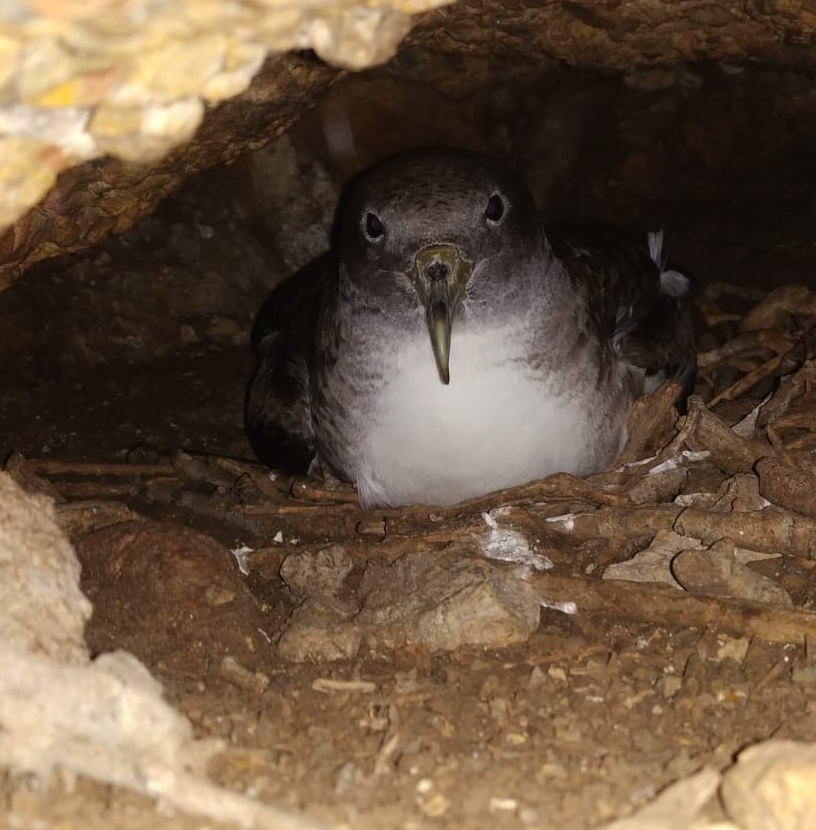
 It was about eight years that the species did not breed in this islet.
  Unfortuntaley, there were some (illegal) visitors. Let 's hope nobody will disturb the new colony for three more weeks.


