
Monday, 13 February 2023
GEDA at the 11-F!

Tuesday, 7 February 2023
New Publications on prospection!
Kralj, J., Ponchon, A., [...], Igual, J.-M.,[...], Tavecchia, G. [...] 2023.Active breeding seabirds prospect alternative breeding colonies. Oecologia .h ttps://doi.org/10.1007/s00442-023-05331-y
Abstract:Compared to other animal movements, prospecting by adult individuals for a future breeding site is commonly overlooked. Prospecting influences the decision of where to breed and has consequences on fitness and lifetime reproductive success. By analysing movements of 31 satellite- and GPS-tracked gull and tern populations belonging to 14 species in Europe and North America, we examined the occurrence and factors explaining prospecting by actively breeding birds. Prospecting in active breeders occurred in 85.7% of studied species, across 61.3% of sampled populations.

Prospecting was more common in populations with frequent inter-annual changes of breeding sites and among females. These results contradict theoretical models which predict that prospecting is expected to evolve in relatively predictable and stable environments. More long-term tracking studies are needed to identify factors affecting patterns of prospecting in different environments and understand the consequences of prospecting on fitness at the individual and population level.
Thursday, 19 January 2023
GEDA at the VIII Jornades de Medi Ambients 2023

Tuesday, 3 January 2023
New publication on Lilford's lizard microbiota!
2023. Insular holobionts: persistence and seasonal plasticity of the Balearic wall lizard (Podarcis lilfordi) gut microbiota. PeerJ 11:e14511 https://doi.org/10.7717/peerj.14511
Summary:Background: Integrative studies of animals and associated microbial assemblages (i.e.,
the holobiont) are rapidly changing our perspectives on organismal
ecology and evolution. Insular vertebrates provide ideal natural systems
to understand patterns of host-gut microbiota coevolution, the
resilience and plasticity these microbial communities over temporal and
spatial scales, and ultimately their role in the host ecological
adaptation.
Methods:Here we used the endemic Balearic wall lizard Podarcis lilfordi
to dissect the drivers of the microbial diversity within and across
host allopatric populations/islets. By focusing on three extensively
studied populations/islets of Mallorca (Spain) and fecal sampling from
individually identified lizards along two years (both in spring and
autumn), we sorted out the effect of islet, sex, life stage, year and
season on the microbiota composition. We further related microbiota
diversity to host genetics, trophic ecology and expected annual
metabolic changes.
 |
| Photo: G. Tavecchia |
Results:All the three populations showed a remarkable
conservation of the major microbial taxonomic profile, while carrying
their unique microbial signature at finer level of taxonomic resolution
(Amplicon Sequence Variants (ASVs)). Microbiota distances across
populations were compatible with both host genetics (based on
microsatellites) and trophic niche distances (based on stable isotopes
and fecal content). Within populations, a large proportion of ASVs
(30–50%) were recurrently found along the four sampling dates. The
microbial diversity was strongly marked by seasonality, with no sex
effect and a marginal life stage and annual effect. The microbiota
showed seasonal fluctuations along the two sampled years, primarily due
to changes in the relative abundances of fermentative bacteria (mostly
families Lachnospiraceae and Ruminococcaceae), without any major
compositional turnover.
Conclusions:These results support a large resilience of the major compositional aspects of the P. lilfordi
gut microbiota over the short-term evolutionary divergence of their
host allopatric populations (<10,000 years), but also indicate an
undergoing process of parallel diversification of the both host and
associated gut microbes. Predictable seasonal dynamics in microbiota
diversity suggests a role of microbiota plasticity in the lizards’
metabolic adaptation to their resource-constrained insular environments.
Overall, our study supports the need for longitudinal and integrative
studies of host and associated microbes in natural systems
Wednesday, 21 December 2022
New publication on climate and sex-ratio!
Santidrián Tomillo, P. 2022 When population-advantageous primary sex ratios are female-biased: changing concepts to facilitate climate change management in sea turtles. Climatic Change 175, 15, doi: https://doi.org/10.1007/s10584-022-03470-4
Abstract: Sea turtles have temperature-dependent sex determination. Because females are produced at high temperatures, increasing global temperature may lead to population feminization. Primary sex ratios (PSR) of sea turtle hatchlings are naturally female-biased, but this translates into a more balanced operational sex ratio because male turtles reproduce more often than females. As a consequence, a balanced PSR and the temperature that produces it (pivotal temperature) are of limited use to guide climate mitigation management because an equal PSR may be demographically suboptimal.
 |
| Photo from wikipedia.org |
Here, I define population-advantageous primary sex ratios (PA-PSR) as the PSR that will tend to be in equilibrium in a population and that will result in balanced operational sex ratios; I then estimate PA-PSR for different reproductive frequencies (years elapsed between reproductive seasons) of adult female and male turtles. I also define population equilibrium temperature (PET) as the temperature that would result in the equilibrium PSR of hatchlings (i.e., PA-PSR). These concepts may help assess the influence of rising temperatures on populations, as they can better indicate if PSRs depart from those at equilibrium. I compared PA-PSR and beach PSR for two populations of sea turtles for which male and female remigration intervals were known and found that a mild or no feminization over the PA-PSR may be occurring. Because PSR varies inter-annually, and hatchlings coming from beaches of different thermal conditions could recruit to the same population, it is critical to estimate beach PSR at the right temporal and spatial scales. Climate mitigation strategies based on these concepts could provide better management guidance for conservation practitioners. Similar approaches could be considered for other female-biased species with temperature-dependent sex determination.
Monday, 12 December 2022
New Publication on Lizard lifspan!
Rotger, A., Tenan, S., Igual, J.-M, Bonner, S. and Tavecchia, G., 2022. Life span, growth, senescence and island syndrome: Accounting for imperfect detection and continuous growth Journal or Animal Ecology,https://doi.org/10.1111/1365-2656.13842
Abstract:
- Small vertebrates on islands are expected to attain a larger body size, and a greater survival than their mainland counterparts. Comparative studies have questioned whether lizards exhibit this set of adaptations, referred to as the ‘island syndrome’.
- We collected data on 730 individuals the endemic Lilford's lizard Podarcis lilfordi throughout a 10-year period on a small island of the Balearic archipelago (Spain).
We coupled a growth function with a capture–mark–recapture model to
simultaneously estimate size- and sex-dependent growth rate and
survival. To put our results into a wider context, we conducted a
systematic review of growth, life span and age at maturity in different Podarcis species comparing insular and mainland populations.

- We found a low average growth coefficient (0.56 and 0.41 year−1 for males and females to reach an asymptotic size of 72.3 and 65.6 mm respectively), a high annual survival probability of 0.81 and 0.79 in males and females, and a large variability between individuals in growth parameters.
- Survival probability decreased with body size in both sexes, indicating a senescence pattern typical of long-lived species or in populations with a low extrinsic mortality. Assuming a constant survival after sexual maturity, at about 2 years old, the average life span was 6.18 years in males and 8.99 in females. The oldest animal was a male last captured at an estimated age of ≥13 years and still alive at the end of the study.
- Our results agree with the predictions of the ‘island syndrome’ for survival, life span and growth parameters. A comparative analysis of these values across 29 populations of 16 different species of Podarcis indicated that insular lizards grow slower and live longer than their mainland counterparts. However, our data differed from other island populations of the same species, suggesting that island-specific characteristics play an additional role to isolation.
- Within this study we developed an analytical approach to study the body size-dependent survival of small reptiles. We discuss its applicability to contrast hypotheses on senescence in different sexes of this species, and provide the code used to integrate the growth and capture–mark–recapture models.

Thursday, 1 December 2022
GEDAi at the Spanish Ornithological Congress 9-13/11/2022 !

A. Sanz-Aguilar was on the scientific committee. A. Santangeli and S. Bolumar made a poster presentation of their work and projects.
Monday, 28 November 2022
New Publication on early-life conditions !
Payo-Payo, A. Sanz-Aguuilar, A. and Oro, D. 2022. Long-lasting effects of harsh early-life conditions on adult survival of a long-lived vertebrate. Oikos e09371, https://doi.org/10.1111/oik.09371
Summary: Early life conditions, especially in long-lived organisms, can have both
immediate and long-lasting effects in vital traits generating
demographic structure across cohorts. Multiple non-exclusive hypotheses
have been proposed to explore this question. For instance, the silver
spoon, the viability selection or the predictive adaptive response
hypothesis, predict that long lasting effects resulting from harsh early
conditions could be negative, positive or vary with current
environmental conditions, respectively. 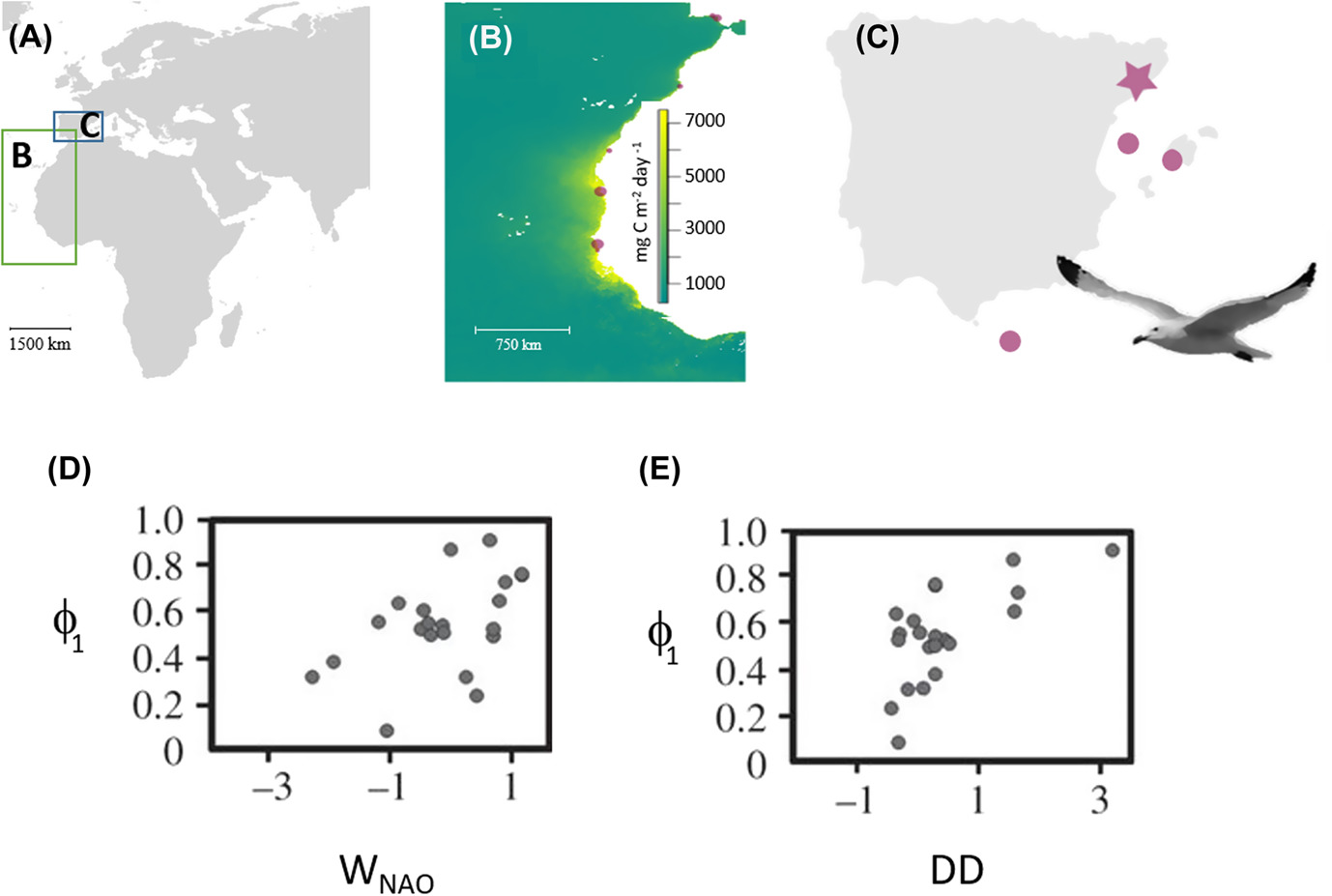 We use an 18-year
capture–mark–recapture dataset on adult Audouin's gulls Ichthyaetus audouinii
to test for these different hypotheses while accounting for age,
breeding experience and large-scale dispersal. Audouin's gull cohorts
experiencing harsh conditions during early life (i.e. nestling period
and first winter) are known to experience lower first year survival.
Here, we show that early life conditions also explained a large
proportion (54%) of adult survival variation among cohorts. However,
adulthood cohorts experiencing poor early life conditions had higher
adult survival, in accordance with the viability selection hypothesis.
Our results also show that apparent inexperienced breeders showed lower
survival than experienced ones. Moreover, adult survival decreased with
age. These results could suggest an increased cost of reproduction for
deferred breeders, individual quality differences or survival senescence
in this population. Overall, our study highlights the importance of
early development, age and breeding experience as potential factors
generating heterogeneity of survival between cohorts. Understanding the
mechanisms driving responses to early life conditions at different life
stages is fundamental to understanding the long-term dynamics of wild
populations.
Subscribe to:
Posts (Atom)
New publication on Shearwaters!
Bolumar Roda,S.,J.M. Igual,J.-M.,Rotger,A., Santangeli, A., Genovart,M., Oro,D., Martín-Pérez,M.,Ferrer-Palou,L.,Sanz-Aguilar,A., & Tave...

-
 Mingozzi, T., Storino, P., Venuto, G., Massolo, A., Tavecchia, G., 2021. Climate warming induced a streth of the breeding season and an incr...
-
Here is a short video by A. Rotger of the exhibition at the Natural History Museum in Soller "When data speak". The exhibition w...
