Corlatti, L., Sanz-Aguilar, A., Tavecchia, G., Giugiatti A., and Pedrotti, L., 2019 Unrevelling the sex- and age-specific impact of poaching mortality with multievent modeling Frontiers in Zoology, https://doi.org/10.1186/s12983-019-0321-1
 Abstract:
 Poaching
is a prominent source of ‘hidden hurdles’, cryptic impacts of human
activities that may hinder the conservation of animal populations.
Estimating poaching mortality is challenging, as the evidence for
illegal killing is not outwardly obvious. Using resighting and recovery
data collected on 141 marked red deer
Cervus elaphus
within the Stelvio National Park (central Italian Alps), we show how
multievent models allow to assess the direct impacts of illegal
harvesting on age- and sex-specific survival, accounting for uncertainty
over mortality causes.
Mortality
caused by poaching was consistently higher for males than for females
in all age classes. In males, the probability of dying from poaching was
higher for extreme age classes, while in females all age classes showed
fairly similar values of poaching mortality. The strong bias in
sex-specific poaching mortality was possibly due to trophy killing in
adult males and ‘bushmeat-like’ killing for private or commercial gain
in young males and in females.

A
robust assessment of age- and sex-specific prevalence of poaching in
wildlife populations is pivotal when illegal killing is of conservation
concern. This provides timely information on what segment of the
population is most likely to be affected. Besides obvious demographic
consequences on small populations, age- and sex-biased poaching
prevalence may contrast with the need to maintain ecosystem complexity
and may alter behavioral responses to human presence. The information
provided by multievent models, whose flexibility makes them adaptable to
many systems where individual-based data is part of population
monitoring, offers a support to design appropriate strategies for the
conservation of wildlife populations.
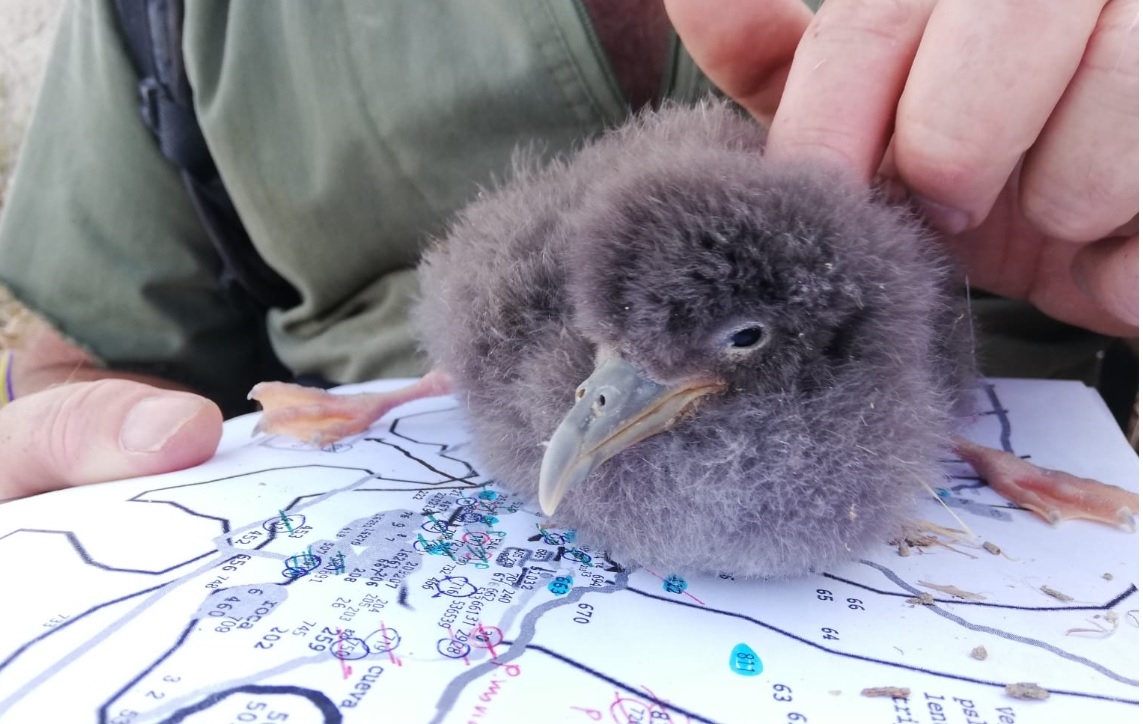 Today was the last visit to the Shearwater colony to measure hatching success.
 A. Sola Galindo was awarded (here) with a "Javier Benedí" fellowship by the IMEDEA within the "JAE Intro ICUs” program of the Spanish Research Council (CSIC). Alfonso will (re)-join the GEDA for three months. His work, supervised by A. Sanz-Aguilar, will deal with seabird movements in relation to oceanic variables. The research will be highly interdisciplinary with collaborations with other three groups of the IMEDEA.
 Each Saturday morning at "Balear Fa Ciencia", Alvaro Luna will share his experience on the study the ecology of those animals that live in the urban enviornment. Here his last interview of Saturday 20th of July 2019 (at 32'45'') about the decrease of once common species.
  Participants have learnt concepts and
techniques to monitor small mammal populations.
Participants have learnt concepts and
techniques to monitor small mammal populations. 

 The Benidorm City Council has prepared panels to inform people what to do when they recover Storm Petrels stranded on city's beaches attracted by the artificial lights. A good initiative promoted by Ana Sanz-Aguilar and the long-term project of Storm Petrel at Benidrom Island.
 Álvaro Luna at "Balears Fa Ciència" (here, min 27) speaking on Urban Ecology and Urban Evolution. Álvaro is finishing his PhD at the University of Sevilla, co-supervised by M. Carrete from the University of Sevilla and A. Sanz-Aguilar from the GEDA (IMEDEA -CSIC/UIB).
  His research is focussing on the adaptation and the ecology of urban fauna. Here is a previous post on Alvaro's book, with an interview by E. Soto.
 Abstract: Poaching
is a prominent source of ‘hidden hurdles’, cryptic impacts of human
activities that may hinder the conservation of animal populations.
Estimating poaching mortality is challenging, as the evidence for
illegal killing is not outwardly obvious. Using resighting and recovery
data collected on 141 marked red deer Cervus elaphus
within the Stelvio National Park (central Italian Alps), we show how
multievent models allow to assess the direct impacts of illegal
harvesting on age- and sex-specific survival, accounting for uncertainty
over mortality causes.
Abstract: Poaching
is a prominent source of ‘hidden hurdles’, cryptic impacts of human
activities that may hinder the conservation of animal populations.
Estimating poaching mortality is challenging, as the evidence for
illegal killing is not outwardly obvious. Using resighting and recovery
data collected on 141 marked red deer Cervus elaphus
within the Stelvio National Park (central Italian Alps), we show how
multievent models allow to assess the direct impacts of illegal
harvesting on age- and sex-specific survival, accounting for uncertainty
over mortality causes.  A
robust assessment of age- and sex-specific prevalence of poaching in
wildlife populations is pivotal when illegal killing is of conservation
concern. This provides timely information on what segment of the
population is most likely to be affected. Besides obvious demographic
consequences on small populations, age- and sex-biased poaching
prevalence may contrast with the need to maintain ecosystem complexity
and may alter behavioral responses to human presence. The information
provided by multievent models, whose flexibility makes them adaptable to
many systems where individual-based data is part of population
monitoring, offers a support to design appropriate strategies for the
conservation of wildlife populations.
A
robust assessment of age- and sex-specific prevalence of poaching in
wildlife populations is pivotal when illegal killing is of conservation
concern. This provides timely information on what segment of the
population is most likely to be affected. Besides obvious demographic
consequences on small populations, age- and sex-biased poaching
prevalence may contrast with the need to maintain ecosystem complexity
and may alter behavioral responses to human presence. The information
provided by multievent models, whose flexibility makes them adaptable to
many systems where individual-based data is part of population
monitoring, offers a support to design appropriate strategies for the
conservation of wildlife populations.


